
Heatsink Design with ColdStream Basic
ColdStream – Basic
Proof your Concept and let ColdStream design a suitable Heatsink or ColdPlate
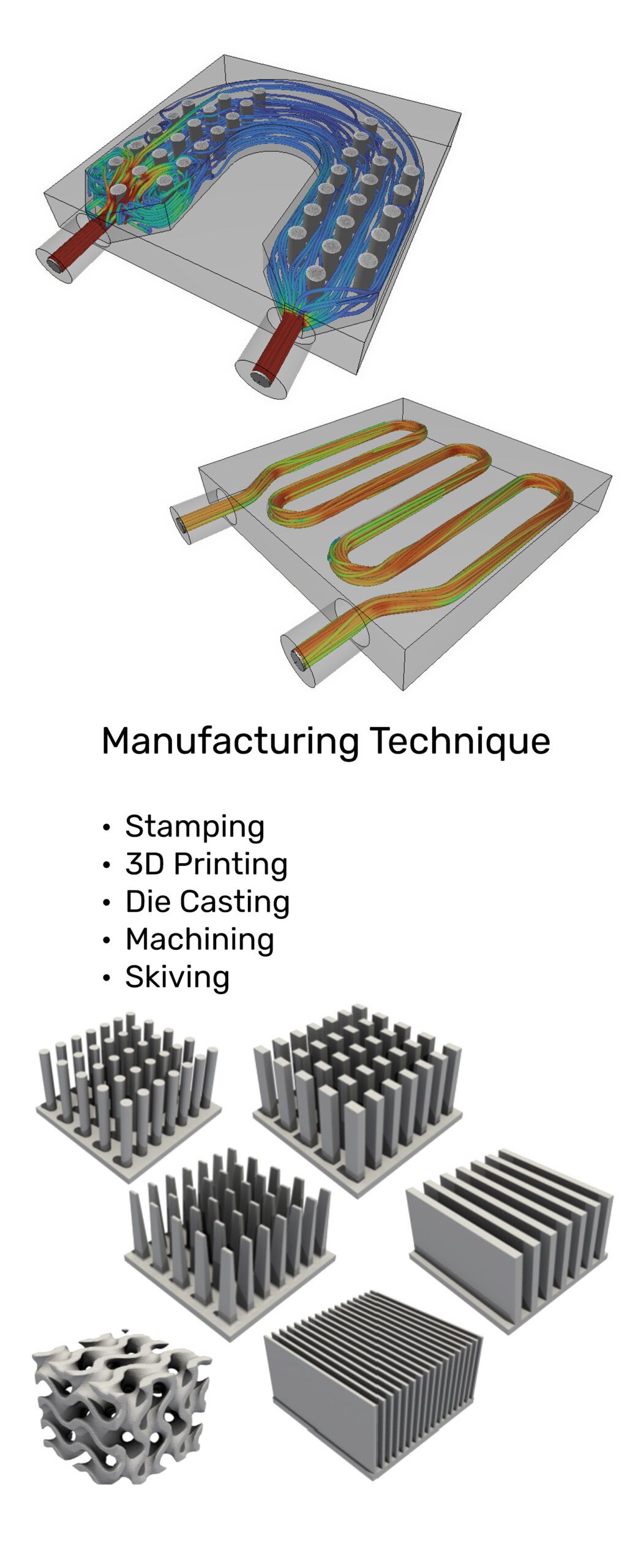
ColdStream Basic allows you to specify the maximum permissible installation size as a 3D volume, select a desired manufacturing technology such as CNC, casting, or extrusion, and automatically design an optimal heat sink. This summarizes the function of the tool in a few words.
ALPHA-Numerics became exclusive Partner for Diabatix Products.
- Germany
- Austria
- Romania
- Hungary
- Poland
- Romania
ColdStream Basic –
for all Industry Fields
Many of the requests we receive do not require a complex CFD tool such as CelsiusEC – often, a quick simulation is sufficient to evaluate a single heat sink concept in space or a coldplate. The aim is to investigate aspects such as heat dispersion in the base plate, the efficiency of the fin arrangement, and the pressure resistance against the supply air (free or forced convection). Through targeted parameter studies, features such as fin height, fin thickness, number, and base plate can be adapted to the requirements. The same applies to the turbulence geometry in the cooling channel of a fluid cooler.
External simulation services for this specialized area quickly lead to costs of € 1.000 to € 3.000 due to the number of runs and necessary reports. These expenses are not economical if such analyses are to be performed regularly.
With ColdStream Basic, you can obtain these services for only € 5.000 per year.
The expert system allows you to analyze existing heat sinks and optimize them fully automatically.
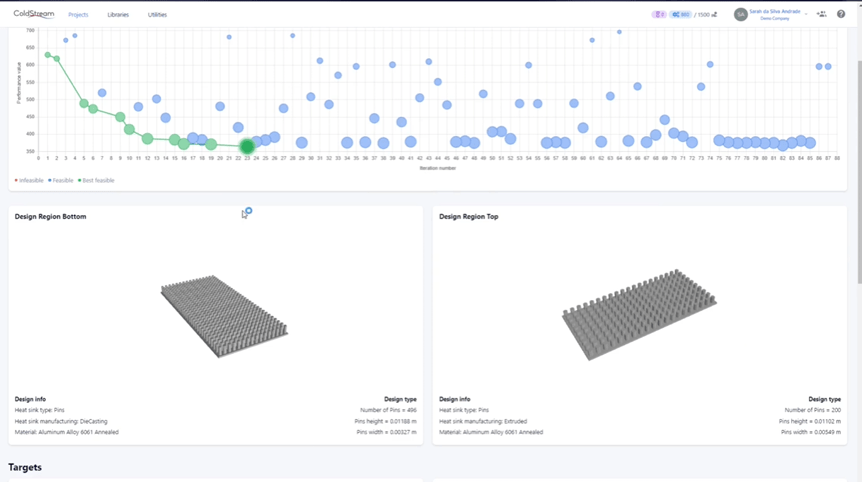
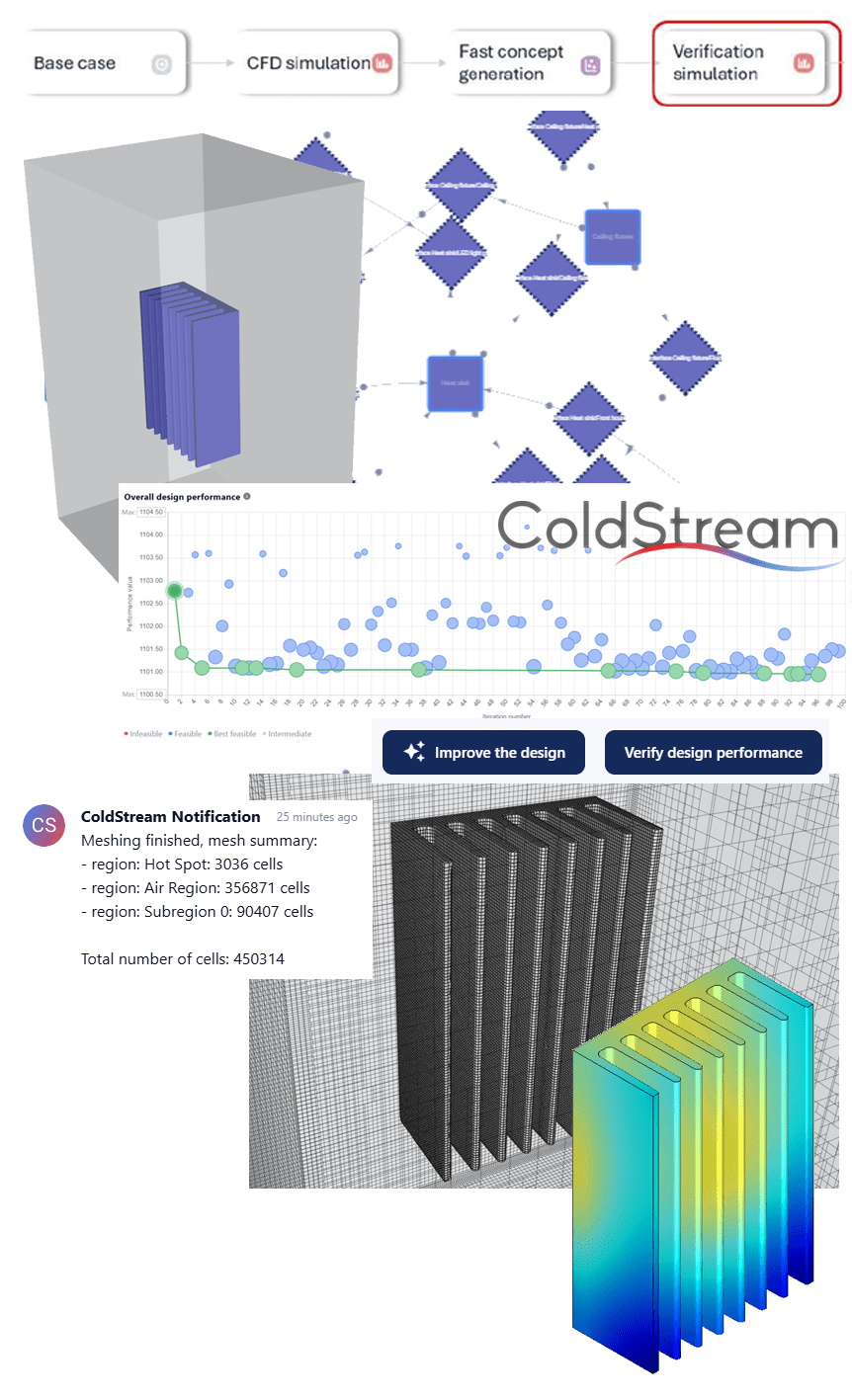
An intelligent algorithm generates a parameterized analysis matrix based on a 2D resistance network. With the help of intelligent version selection, it quickly approaches the optimum and finally checks the newly designed 3D model with a complete CFD calculation.
You can visualize the results via the software portal or by transferring data to ParaView and pass them on as a Step file to tools such as CelsiusEC for holistic device simulation or directly to production.
Who says a standard heat sink design isn’t enough?
How standard designs can achieve better and faster thermal results
Much of the frustration in thermal engineering stems not from a lack of expertise, but from the way workflows for evaluating and optimizing heat sinks are structured.
Traditional CFD loops can be fast, but the iteration process can be slow and manual, and even after days of work, the question always remains in the back of your mind: Is this really the best design, or simply the best I could explore?
This is where the idea of standard designs in ColdStream Basic becomes powerful.
They are not shortcuts or simplified templates. They are highly accurate reference designs that already demonstrate solid thermal behavior and realistic engineering constraints.
More importantly, they help define the course of the optimization process.
Instead of exploring blindly, you start with something that already behaves in a predictable and understood manner. It can then be used to determine where performance improvements should be directed.
If the application requires something highly specialized, you don’t have to stop at the standard design, but build on it through a generative design process that takes into account specific project requirements such as constraints, materials, and manufacturing methods.
What Are Heat Sink Design Basics
To effectively dissipate heat, it is important to understand the basic principles and considerations for designing a heat sink. Firstly, heat sinks should have pins/fins to increase surface area for better heat transfer through convection and radiation.
Secondly, high thermal conductivity materials like aluminum and copper are ideal for heat sinks.
They efficiently transfer heat from the component to the surface for effective dissipation.
Lastly, heat sink design relies on proper airflow to dissipate heat. Optimal cooling efficiency is achieved by considering airflow patterns and the heat sink’s placement and orientation. Natural convection or forced convection with fans can ensure unobstructed airflow.
Engineers must consider surface area, thermal conductivity, and airflow when designing heat sinks for optimal operating temperatures of electronic components. Fins can increase surface area, high thermal conductivity materials can be used, and airflow patterns must be considered. This ensures safe and effective operation.
What is an optimal Heat Sink design?
Heat sinks are used to cool electronic components by dissipating heat away from them. To design an optimal heat sink, key factors such as maximizing heat transfer efficiency and minimizing ambient air temperature should be considered before constructing the heat sink.
Thermal conductivity: Heat sinks require materials with high thermal conductivity, such as aluminum and copper alloys.
Surface area: The larger the surface area of the heat sink, the better it can dissipate heat. This is typically achieved by incorporating fins, which increase the effective surface area for heat transfer.
Fin design: Fins must be thin and spaced properly for effective heat dissipation. Different fin shapes can be used based on the application’s needs.
Heat sink base: The heat sink should have good contact with the cooling component. A flat, smooth base helps ensure efficient thermal contact, reducing thermal resistance.
Airflow: To remove heat from a heat sink, airflow should be unobstructed through natural or forced convection. Position the heat sink to optimize heat dissipation with the direction of airflow.
Thermal interface material (TIM): The TIM is applied between the heat sink and the component to fill any microscopic gaps and improve thermal conductivity. Proper selection and application of high-quality TIM can significantly enhance heat transfer efficiency.
System integration: Consider system requirements like space, weight, and compatibility when designing a heat sink. Integration into the system should be seamless.
Optimization and analysis: Engineers can improve cooling by using thermal simulations like CFD analysis to optimize heat sink design. By assessing factors such as fin density, shape, and airflow patterns, they can achieve superior cooling results. Efficient heat dissipation is key to maintaining optimal performance and longevity of electronic systems. By designing an optimal heat sink, thermal energy can be effectively dissipated to keep components within their safe operating range.